- Preventing identity fraud: By verifying customer identities, businesses can ensure that fraudsters cannot use stolen or fake identities to open accounts or conduct transactions.
- Reducing money laundering risks: KYC processes help identify suspicious activity and flag high-risk customers, such as politically exposed persons (PEPs), making it harder for criminals to launder money through legitimate businesses.
- Enhancing Trust and Security: Customers are more likely to trust businesses that prioritize security and transparency, leading to stronger customer relationships.
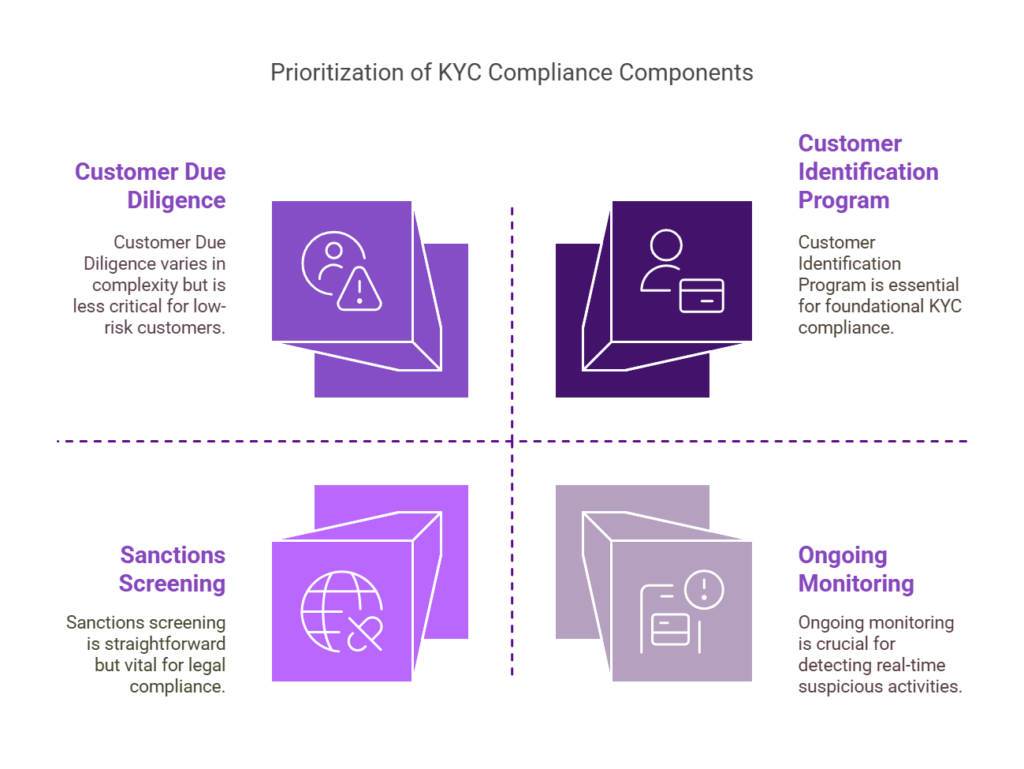 A robust KYC compliance program goes beyond basic identity verification. It includes the following components: 1. Customer Identification Program (CIP) The CIP is the foundation of KYC compliance. It involves collecting and verifying customer information, such as name, date of birth, address, and identification numbers. Advanced solutions like use AI-powered tools to cross-check this data against global databases for accuracy. 2. Customer Due Diligence (CDD) CDD involves assessing the risk level of each customer. Low-risk customers may require minimal verification, while high-risk customers (e.g., politically exposed persons (PEPs) or those from high-risk jurisdictions) undergo enhanced due diligence (EDD). 3. Ongoing monitoring KYC compliance doesn’t end after onboarding. Continuous monitoring of customer transactions and behavior helps detect suspicious activity in real time. Fraud orchestration platforms like fcase automate the detection and response to potential threats. 4. Sanctions screening Businesses must screen customers against global sanctions lists to ensure they are not dealing with individuals or entities involved in illegal activities. The role of fraud prevention solutions in strengthening KYC compliance Fraud prevention solutions and KYC compliance go hand in hand. While KYC ensures that customers are verified at the onboarding stage, fraud detection and prevention solutions provide ongoing protection against evolving threats. Together, they create a comprehensive defense against financial crimes. Here’s how fraud prevention solutions enhance KYC compliance:
 - Automated identity verification: Platforms like Udentify use AI and machine learning to verify identities in real time, reducing manual errors and speeding up the onboarding process.
- Behavioral analytics: Tools like aiReflex analyze customer behavior to detect anomalies and flag potentially fraudulent activities, even after the initial KYC check.
- Seamless integration: Modern fraud prevention tools integrate seamlessly with KYC systems, creating a unified approach to risk assessment and compliance.
- Digital identity solutions: Blockchain-based digital identities and decentralized identity systems are gaining traction, offering a more secure and efficient way to verify customers.
- Biometric authentication: Facial recognition, fingerprint scanning, and voice authentication are becoming standard in KYC processes, enhancing accuracy and security.
- Regulatory Technology (RegTech): RegTech solutions are automating compliance processes, reducing the burden on businesses and ensuring adherence to evolving regulations.
- High volume of transactions: The sheer number of transactions makes it difficult to manually verify each one, increasing the risk of oversight.
- Complex regulatory landscape: Financial institutions must comply with multiple regulations across different jurisdictions, making compliance a complex and resource-intensive process.
- Evolving threats: Fraudsters are constantly developing new tactics, requiring financial institutions to stay ahead of the curve.
- Streamlined onboarding: Automated identity verification tools enable financial institutions to onboard customers quickly and securely.
- Enhanced risk assessment: By integrating KYC data with fraud detection tools like aiReflex, financial institutions can assess risk more accurately and in real time.
- Proactive fraud prevention: Continuous monitoring and ongoing monitoring help detect and prevent suspicious activity before it escalates.
- Leverage technology: Use AI-powered tools to automate identity verification and fraud detection.
- Conduct regular audits: Regularly review and update KYC processes to ensure compliance with evolving regulations.
- Train employees: Provide ongoing training to employees on KYC compliance and fraud prevention best practices.
- Monitor high-risk customers: Implement enhanced due diligence (EDD) for high-risk customers, such as politically exposed persons (PEPs).
- Integrate systems: Use fraud orchestration platforms like fcase to create a unified approach to KYC compliance and fraud prevention.
Source: https://www.fraud.com/post/kyc-compliance